


| Greek | Meaning | Notes |
|---|---|---|
| ἀποθνήσκω | I die | |
| ἀποκτείνω | I kill | |
| δέχομαι | I receive | |
| ἑτοιμάζω | I prepare | |
| θεραπεύω | I heal | cognate: therapeutic |
| πιστεύω | I believe | |
| νῦν | now | |
| ἔτι | yet, still | |
| οὐκέτι | no longer | |
| τότε | then | |
| σκοτία | darkness | |
| μέν ... δέ | on one hand, on the other hand | used in contrasting statement. Sometimes the μέν is not translated while δέ is translated as "but." |
| ἀδύνατος | unable | cognate: dynamite |
| ἐξουσία | authority |
| Singular | ||
| Form | Meaning | |
|---|---|---|
| 1st | ἔλυον | I was loosing |
| 2nd | ἔλυες | yous were loosing |
| 3rd | ἔλυε | he/she/it was loosing |
| Plural | ||
| Form | Meaning | |
| 1st | ἐλύομεν | we were loosing |
| 2nd | ἐλύετε | youp were loosing |
| 3rd | ἔλυον | they were loosing |
- The imperfect is made of these four elements: augment, stem, thematic vowel, endings
- The augment adds ε at the beginning of the word.
- The augment indicates that the tense is in the past time.
- When a verb begins with a consonant, a simple ε is placed in front to make a new syllable.
- βάλλω = I am throwing
- ἔβαλλον = I was throwing
- When a verb betins with a vowel, the augment joins with the vowel to make a longer vowel
- ε + α = η thus ἀκούω becomes ἤκουον
- ε + ε = η thus ἐγείρω becomes ἤγειρον
- ε + ο = ω thus ὀφείλω becomes ὤφειλον
- In compound verbs, the augment comes after the preposition and just before the verb stem.
- Thus ἐκβάλλω becomes ἐξέβαλλον.
- Note that for good sound ἐκέβαλλον changes to ἐξέβαλλον.
- If the preposition ends with a vowel, some joining or elision takes place.
- Thus ἀποκτείνω (which is ἀπὸ + κτείνω) would become ἀπο + ε + κτείνον
- but the οε join together to become just ε with the resulting form: ἀπέκτεινον.
- ἀπάγω becomes ἀπῆγον
- ἀναβαίνω becomes ἀνέβαινον
- καταβαίνω becomes κατέβαινον
- ἀποστέλλω becomes ἀπέστελλον
- συνάγω becomes σύνηγον
- ἐκβάλλω becomes ἐξέβαλλον
- Thus ἐκβάλλω becomes ἐξέβαλλον.
- Some exceptions to remember:
- θέλω becomes ἤθελον
- μέλλω becomes ἤμελλον
- ἐχω becomes εἶχον
The stem
- remove the final omega from the vocabulary word
- thus λεγ- is the stem of λέγω
- The thematic vowel is also called the "variable vowel"
- The thematic vowel is ο in front of an ending which begins with μ or ν.
- The thematic vowel is ε in front of an ending which does NOT begin with μ or ν.
The imperfect endings
- -ν, -ς, none, -μεν, -τε, -ν (or -σαν)
- Here's how to learn them. Remember one of the following silly sentences:
- Now some blank men tell news (Now some blank men tell news)
- Norma says nothing, men tell Norma
- Now some space men test new sand
- Notice that the first person singular and the third person plural have identical forms.
- Only the context will reveal the meaning.
Imperfect meaning
- The imperfect tense indicates on-going action in past time
- While the present form ἀκούω means I am hearing
- the imperfect form ἤκουον means I was hearing
- Both the present tense and the imperfect tense describe continuous or on-going action.
- The difference is the time of the action.
- The action may be continued as in I was hearing
- The action may be repeated as in I kept hearing
- The action may be customary as in I used to hear
- The action may be attempted as in I tried to hear
- The action may be initiated as in I began to hear
| Singular | ||
| Form | Meaning | |
|---|---|---|
| 1st | ἤμην | I was |
| 2nd | ἦς | yous were |
| 3rd | ἦν | he/she/it was |
| Plural | ||
| Form | Meaning | |
| 1st | ἦμεν | we were |
| 2nd | ἦτε | youp were |
| 3rd | ἦσαν | they were |
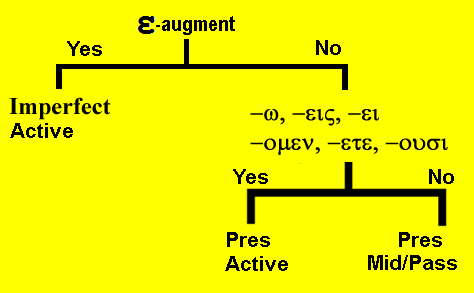
VERB IDENTIFICATION
- To identify a verb, ask yourself the following questions:
- Does it have an augment?
- Yes, then it is a past tense. The only past tense you've studied is Imperfect
- No, then it is present tense
- Does it have the active endings?
- If yes, it is present indicative active.
- If no, then it is present indicative middle/passive.
- Does it have an augment?
Translate the following:
- τότε ἠκούομεν τῆς φωνῆς αὐτοῦ, νῦν δὲ οὐκέτι ἀκούομεν αὐτῆς.
- ἐκεῖνοι μὲν οἱ ἁμαρτωλοὶ μένουσιν ἐν τῇ σκοτίᾳ, οὖτοι δὲ εἰσέρχονται εἰς τὴν βασιλείαν τοῦ θεοῦ.
- ἐν ἐκείναις ταῖς ἡμέραις ὁ μεσσίας ἐθεράπευε τοὺς ὄχλους καὶ ἔσωζεν αὐτοὺς ἀπὸ τῶν ἁμαρτιῶν αὐτῶν.
- ἡτοίμαζον τὰς καρδίας αὐτῶν πονηροὶ ἄνθρωποι ὅτι ἤκουον τῶν γραφῶν καὶ ἐπίστευον αὐτάς.
- διὰ μὲν τήν ἀγάπην τοῦ θεοῦ ἀποθνήσκομεν ἐν τῇ βασιλείᾳ τοῦ θεοῦ, δεχόμεθα δὲ τὴν ζωὴν σὺν τῷ υἱῷ αὐτοῦ.
- πονηροὶ ἦτε, ἀγαθοὶ δέ ἐστε.
- νῦν μὲν διδασκόμεθα ὑπὸ τοῦ κυρίου, τότε δὲ ἐδιδάσκομεν τὴν ἐκκλησίαν.
- ὁ μεσσίας ἀπέστελλεν ἀγγέλους πρὸς ἡμᾶς.
- οἱ ἄνθρωποι οἱ πονηροὶ ἀπέκτεινον τὰ τέκνα σὺν τοῖς διδασκάλοις αὐτῶν.
- ἐν τῷ κόσμῳ ἦν καὶ ὁ κόσμος οὐκ ἐγίνωσκεν αὐτόν.

πῶς δυσκόλως οἱ τὰ χρήματα ἔχοντες εἰς τὴν βασιλείαν τοῦ θεοῦ εἰσπορεύονται.
1"How hard it is for those who have riches to enter the kingdom of God!" (Luke 18:24)
1"How hard it is for those who have riches to enter the kingdom of God!" (Luke 18:24)